A JBD pack in the garage, a Victron in the van, a power
station on the table, and a different vendor app for each one.
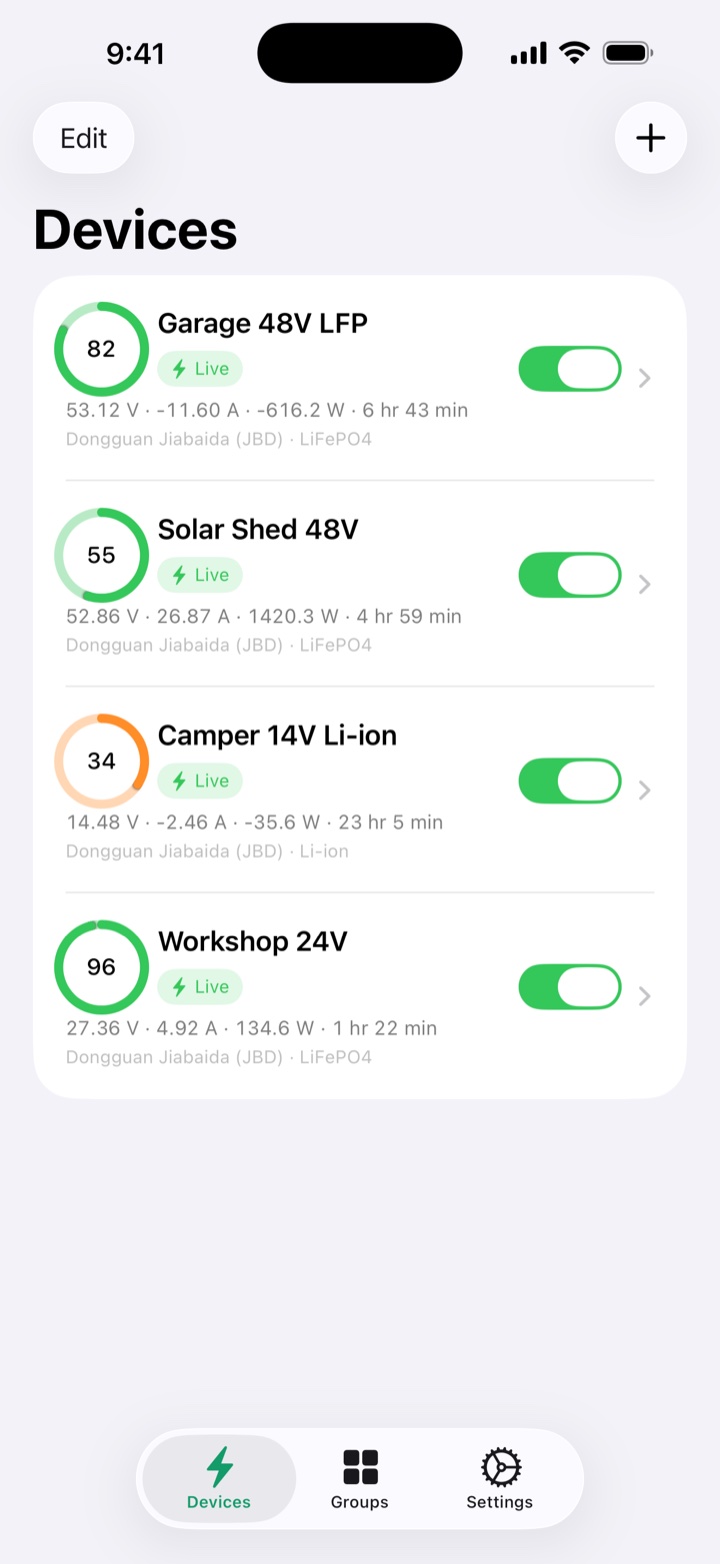
BMS Pal ends the app-hopping: every pack you own in one live
list, with state of charge, voltage, current, watts, and time
remaining. Device detail pages have tools for a deep dive into
your devices.
For iPhone, iPad, and Apple Silicon Macs.
Free download · 7-day trial · US$5 unlocks it for good.
The whole fleet, one list, live.
Protocols
Major BMS protocols, power stations, and monitors. And counting.
Eight battery-management-system (BMS) families at launch, in
two tiers: BMS boards get the deep integration; battery
monitors and power stations get their essentials, in the
same list.
BMS boards — every byte they’ll give us
BMS data from inside your DIY packs and commercial
batteries. These get the full treatment: per-cell voltages
with balancing indicators, protection alerts, chemistry
detection, and confirmation-gated FET control.
Sealed systems that still belong on the same screen. BMS Pal
reads the essentials each one exposes, and they get charts
and history like any other pack.
Victron incl. encrypted advertisingJunctek KL-F shunt monitorsBluetti power stationsJackery power stationsEcoFlow power stations
Who reports what
Ten columns. Swipe sideways for the rest.
Data supported per device family. A check mark means the
value is read from the device; a dash means it is not
available for that family.
Device family
SoC
Volts
Amps
Watts
Temp
Cells2
Alerts
Config3
FET4
Sanity Check5
BMS boards
JBD incl. XiaoXiang & legacy
✓
✓
✓
✓
✓
✓
✓
✓
✓
✓
JK
✓
✓
✓
✓
✓
✓
✓
—
✓
✓
Daly
✓
✓
✓
✓
✓
✓
✓
—
✓
✓
Battery monitors & power stations
Victron SmartShunt, BMV & co.
✓
✓
✓
✓
—
—
—
—
—
—
Junctek KL-F shunts
✓
✓
✓
✓
✓
—
—
✓
—
—
Bluetti
✓
—
—
✓
—
—
—
—
—
—
Jackery
✓
—
—
—
✓
—
✓
—
—
—
EcoFlow1
✓
✓
✓
✓
✓
✓
—
—
—
—
1 Full EcoFlow telemetry rides the optional
EcoFlow account sign-in; straight over Bluetooth, state of
charge still comes through.
2 Per-cell voltage bars; live balancing
indicators on JBD, JK, and Daly.
3 Configuration reads: JBD answers a full
parameter pull; Junctek meters send their settings along with
the data stream.
4 FET control is write mode: off by default
behind a master switch and a per-command confirmation, and
every attempt is logged.
5 Sanity Checks review protection settings and
configuration, so they run on BMS boards, where the setup can
actually be changed.
Where a device doesn’t report capacity, chemistry, or
cell count, BMS Pal asks once when you add it.
All eight families on my bench
92 wire-protocol variants documented
1,100+ automated tests in the suite
Pack that will not identify? Unrecognized-device reports are
exactly how this table grows a row; see
Help me help you.
Features
What it does.
Every system in one place
Every pack, whatever BMS is inside, lands in the same live
list, up to eight connected at once, side by side. No vendor
apps required.
Bundled batteries
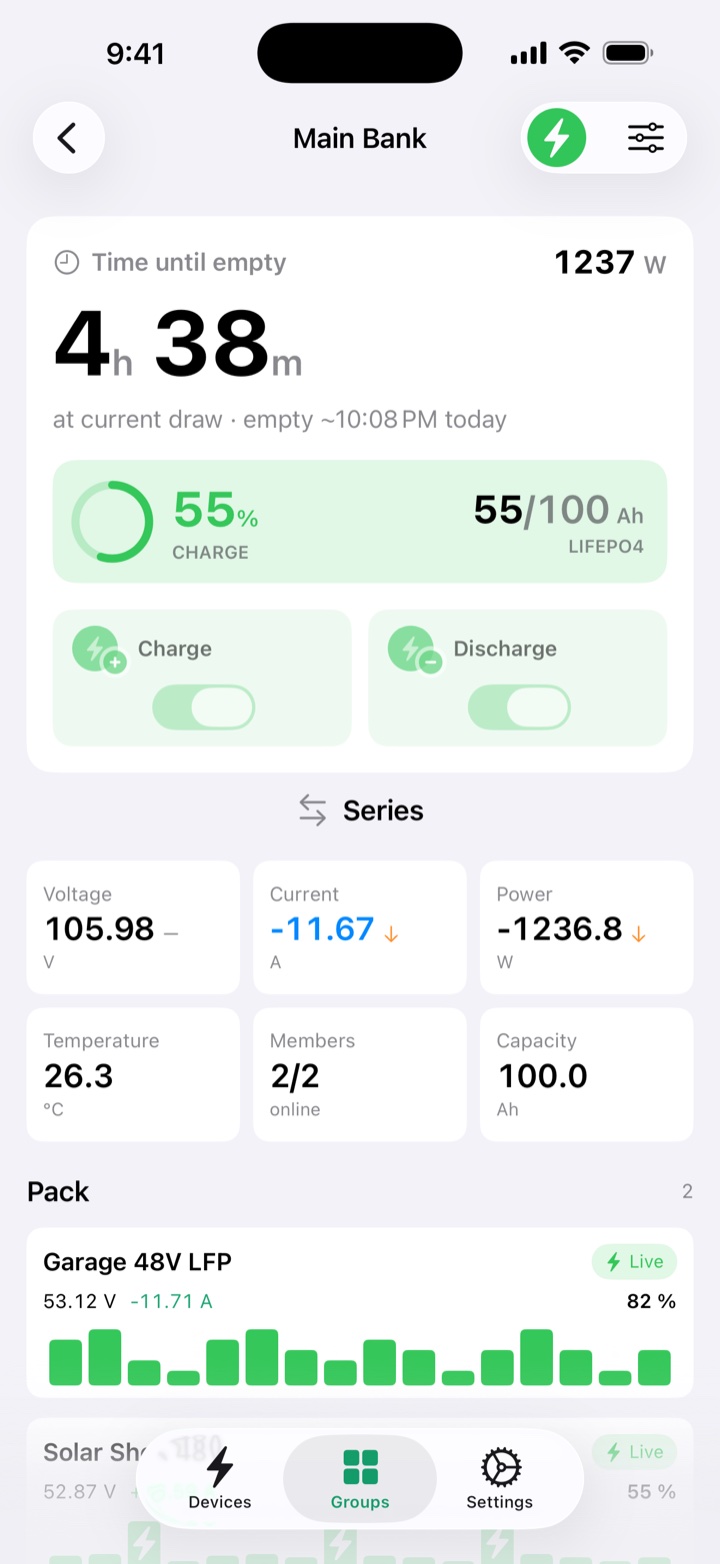
Packs that work as one bank read as one battery: group them
series, parallel, or series-parallel and get combined voltage,
current, and state of charge, computed from the members.
Your BMS, decoded
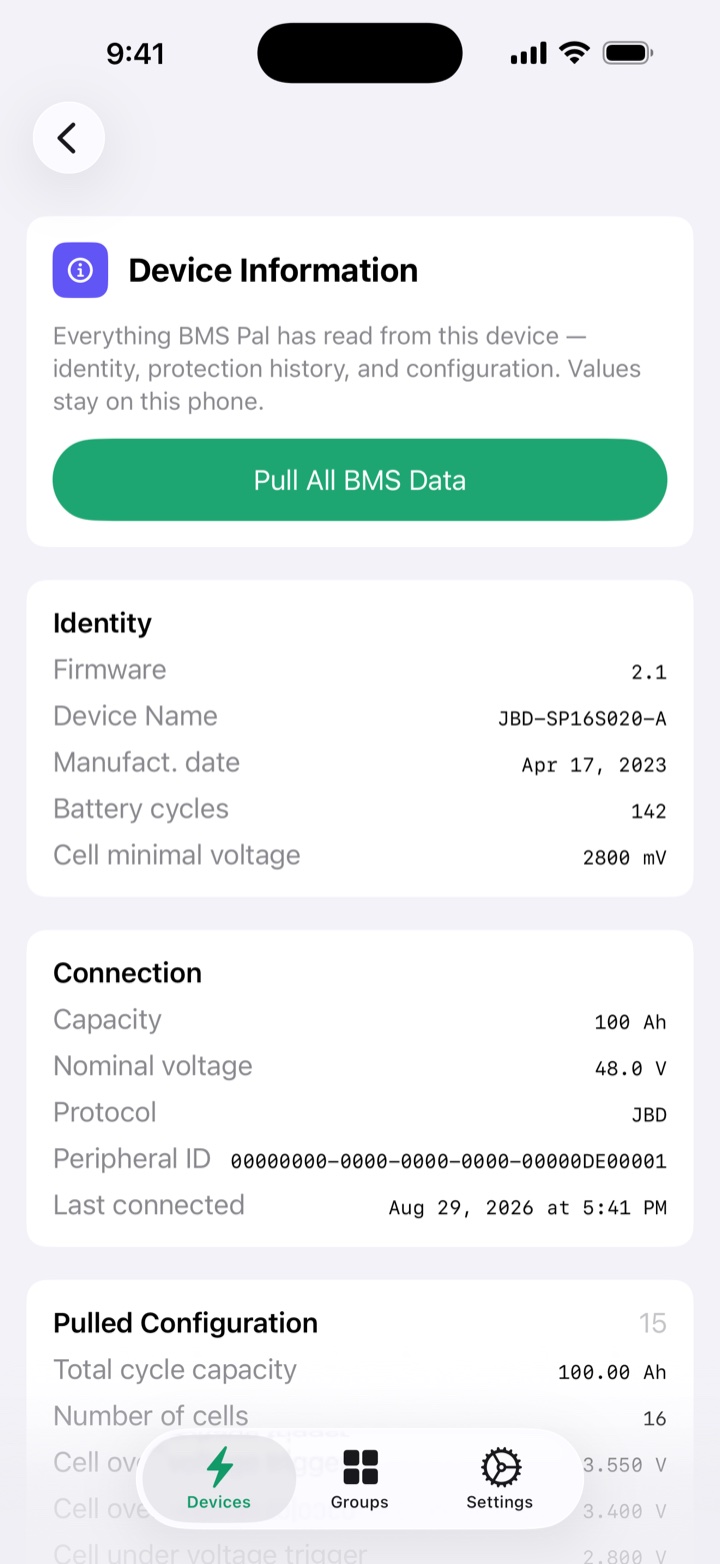
See how the board is actually set up: hardware and firmware
details and its protection settings, read straight off the BMS.
No vendor app required.
The everyday kit, whatever you run
Live telemetry
Voltage, current, power, temperature, and state of charge
stream in as your BMS reports them. Charts hold the last week,
so you can see what happened while you slept.
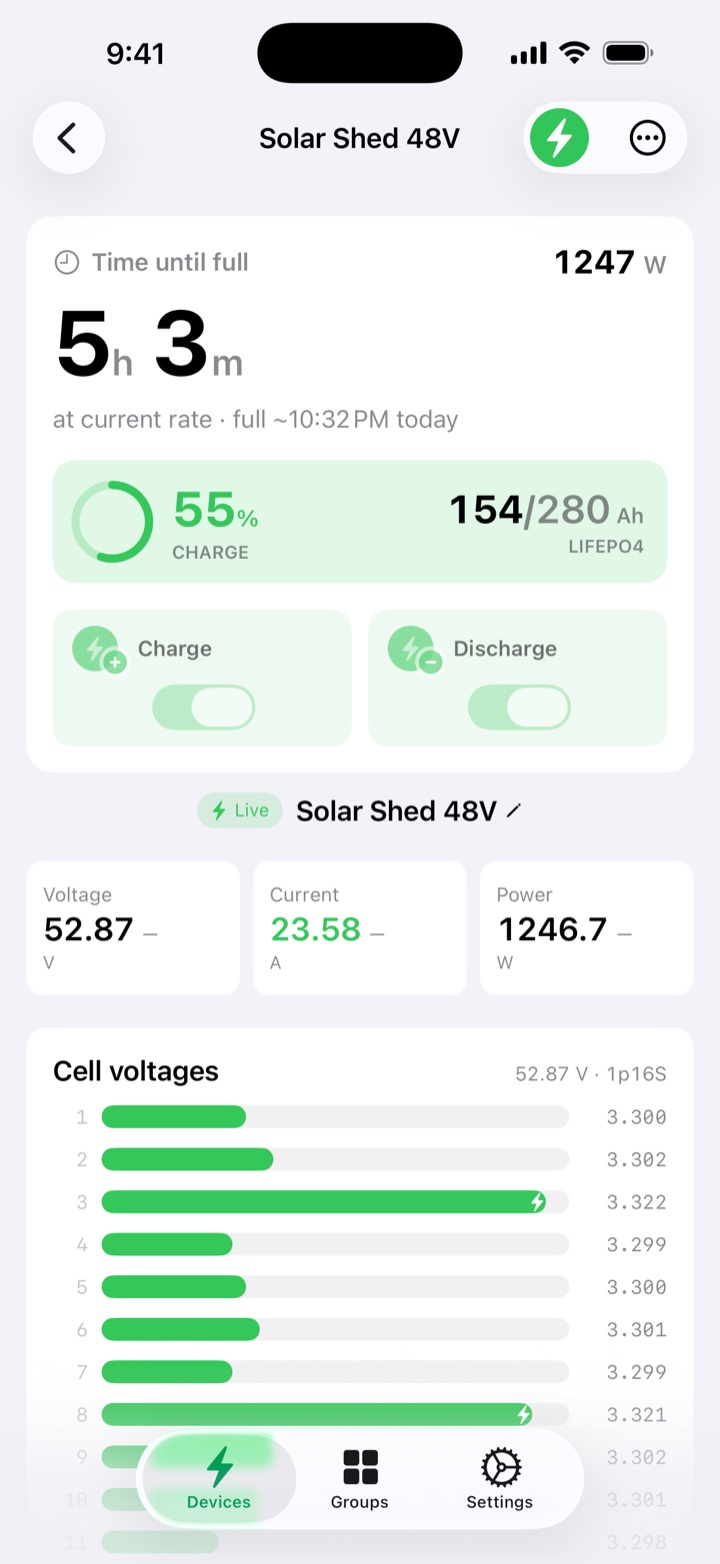
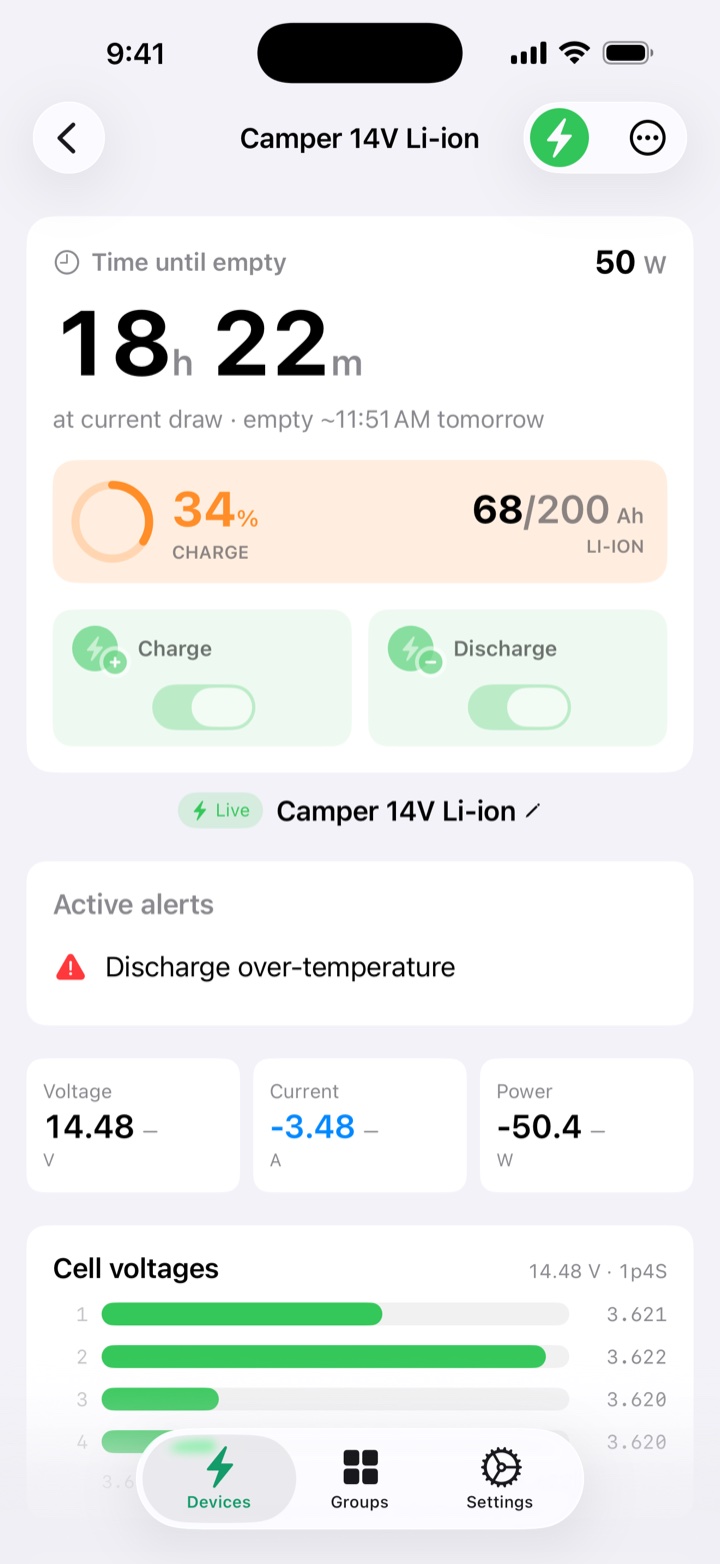
Time until empty, time until full
How long until the pack is empty, and how long until it
is full: computed from live draw on any pack that reports
it, smoothed so it reads steady, shown on the device page
and right in the device list. Most vendor apps never show
it.
Capacity tests
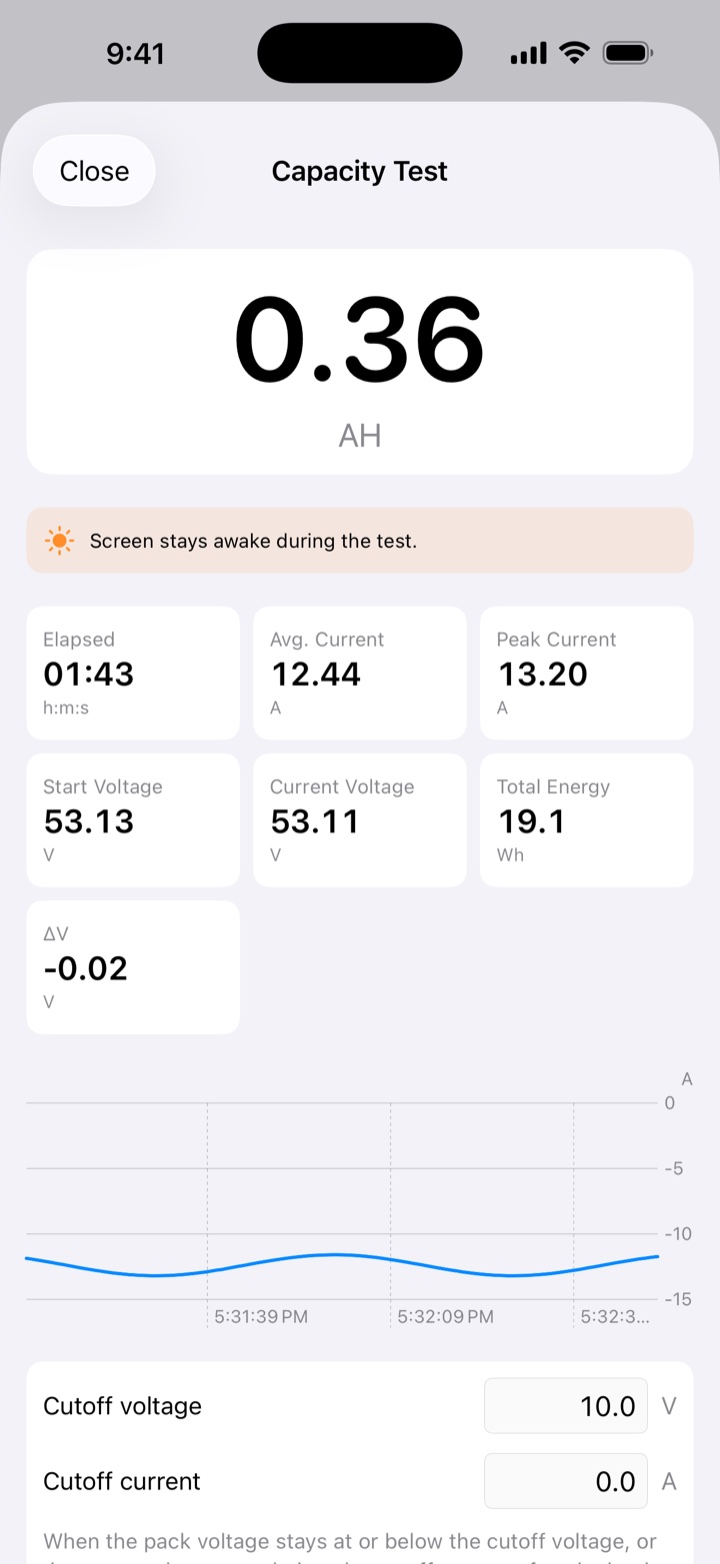
Run a real discharge test on any pack that reports current:
BMS Pal integrates it over time against your cutoff and files
the result in the pack’s history, so “how many amp-hours,
really?” finally gets a measured answer.
The deep end, when it’s a BMS board
Per-cell detail
Every cell gets its own bar, down to the millivolt. Cells the
BMS is actively balancing light up with a bolt, so you can watch
the spread tighten in real time.
Chemistry detection
BMS Pal reads your pack’s protection thresholds and works out
whether it is LiFePO4 or Li-ion on its own. You can override it:
you know your pack better than anyone.
Alerts, plainly stated
When the BMS raises a protection event (over-temperature,
cell over-voltage), it appears on the device page in plain
language. No sirens, no red flashing. Just the facts.
Sanity Check
Not sure those numbers are fine? Send a snapshot of your pack
for a second opinion and get a short, plain-language read back.
Only ever when you tap the button. See the privacy policy.
Write mode, off by default
Toggling charge or discharge FETs is serious business on a
high-energy pack. Writes sit behind a master switch plus a
per-command confirmation, and every attempt is logged.
Screenshots
See it in action.
Time to full, cell bars, balancing bolts and all.
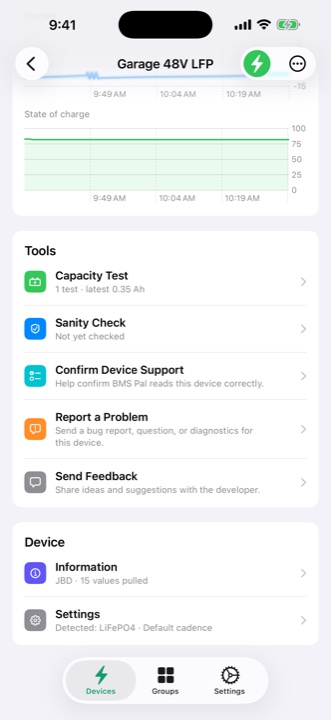
Every tool for the pack, one page.
Identity and configuration, read off the board.
An alert, calmly stated.
Two packs in series, one number.
Capacity test, mid-run.
Shots show the built-in demo fleet: the exact shipping UI, driven
by simulated packs so every feature is visible at once.
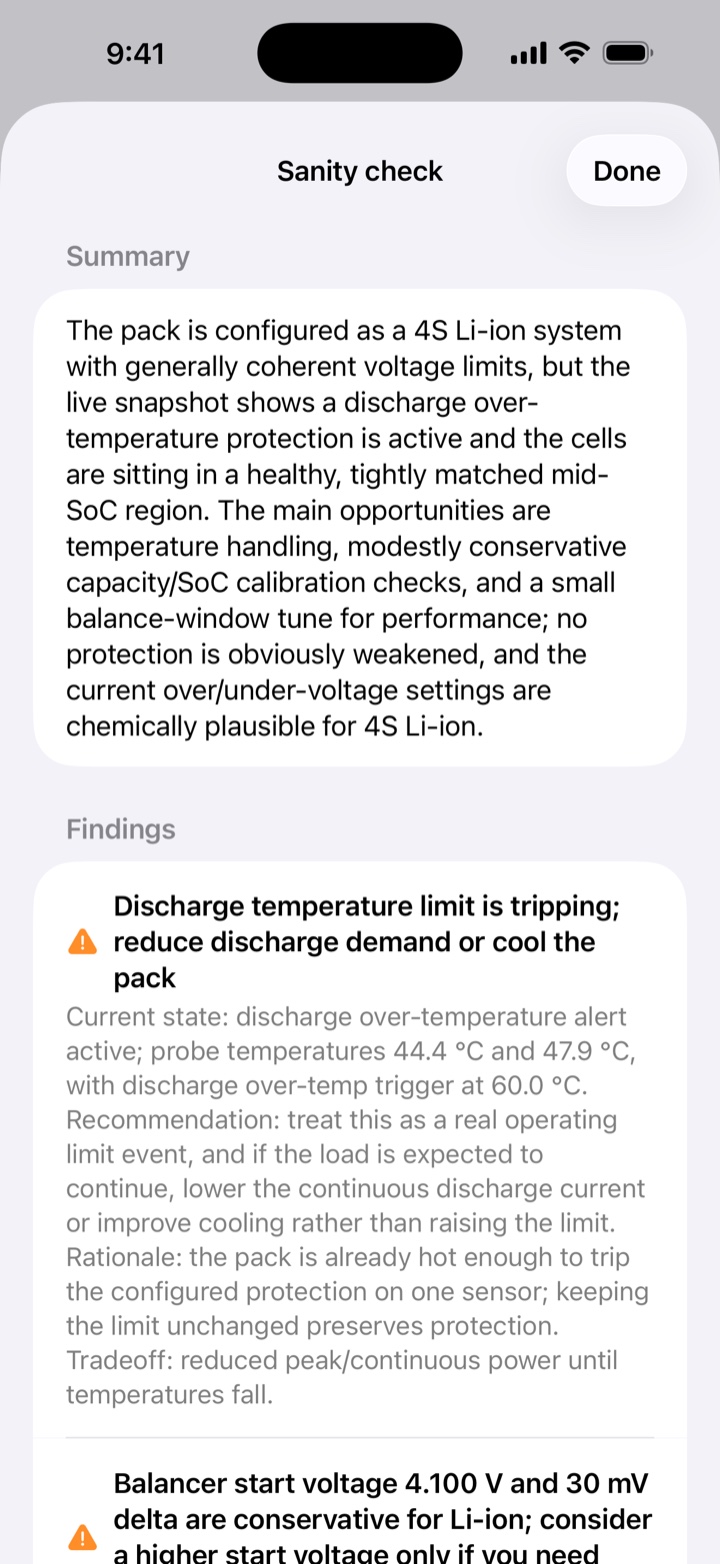
A real report: the demo camper’s over-temperature alert,
caught and explained.
Sanity Checks
A second opinion, in plain English.
Numbers are only half the story. Is a 30 mV spread fine?
Is that under-voltage cutoff right for Li-ion? Tap
Run Check and BMS Pal sends the pack’s
configuration and live data for an AI
review across six dimensions, and hands back a written
verdict: a summary up
top, then findings with severity, the reasoning behind each
one, and the tradeoff of every suggested change.
Findings come graded: what needs action, what to
verify, and what to leave exactly as it is.
You see exactly what is sent before anything leaves
your phone, copy button included, and only when you tap.
Reports stay with the device, so you can change a
threshold and check again.
For BMS boards: a second opinion pays off where the
setup can actually be changed. 25 checks included; $2
for 25 more.
The backstory
The app I wished I had.
BMS Pal started as a four-item wishlist.
1
An app that
did not upsell me or demand a subscription. (You would be
surprised how aggressively Apple encourages the subscription
model.)
2
Native OS
graphics. Too many vendor apps look like they shipped with
Windows 98.
3
All my
devices on screen at the same time.
4
Oh, and it
had to handle my tent trailer’s pack.
Then it got a little crazy. Scope creep
is real.
5
“How
about building a capacity test?” Okay!
6
“Can
I pass my BMS data to an AI to double-check the
configuration?” Yes. That became Sanity
Checks.
7
“What
about devices the app has not seen?” So it grew a
device-confirmation system.
8
“What
happens when my friends find bugs?” A bug-reporting
system, with replies. Okay!
9
“How
many other devices can I integrate? Hey, Dad, can I borrow
your EcoFlow for a few days?”
10
Scott:
“Think we can find a Bluetooth shunt for my trailer
and add that too?” Hey, let’s try! (If you
are wondering why the coverage table has a Junctek KL-F row:
that is why.)
Roadmap
What’s next.
Version 1 is the starting line. This list is roughly
ordered, and the top of it belongs to you.
Your requested featuresSend Feedback in the app; I read everything, and
real use reorders this list.
Your requested devicesDevice reports decide which family gets the next row
in the coverage table.
Your bug reportsFixes for misbehaving packs jump the queue.
Home Screen and Lock Screen widgets
Apple Watch app and complications
More languages
Android support
The top three feed from one place:
Help me help you, right below.
Help me help you
Your unique setup makes the app better.
BMS Pal is one developer and one bench. The eight families above
are the ones I can test myself; the long tail of firmware
quirks and rebranded boards lives on your bench. The app has
three buttons for exactly that. None of them are automatic, and
none of them are paywalled.
Report a Problem
A pack that will not connect, a value that reads wrong, a
device that will not identify? Send a report with diagnostics
straight from the device page (or from the scan screen for
mystery hardware). Replies land in the app’s Support inbox,
so you will actually hear back.
Confirm Device Support
Got a model that reads correctly? One tap sends its model
and firmware details so I can mark your exact hardware as
confirmed, and the next person shopping for a BMS knows
theirs will work before they buy.
Send Feedback
Ideas, gripes, feature requests. Same two-way channel:
I read everything, and you will see replies in your Support
inbox, with a badge so you do not miss them.
You tap the button, you see the exact payload before it goes
(copy button included), and nothing ever leaves in the
background. Support stays reachable even if your trial ran
out long ago.
Vendors
Make battery gear? Join the fun.
If you build BMS boards, power stations, or battery monitors
and want them supported well, I would love to work with you.
Protocol documentation, a loaner unit, or an engineer on a
short call: any of the three turns into an integration that
is bench-tested before it ships. Your customers get a good
native app on day one, and the coverage table above grows
another row.
The app collects nothing on its own, and this site holds
itself to the same standard.
No account. Ever.There is nothing to sign up for, no install ID, and no
per-user identifier anywhere in the system.
No analytics, no trackers, no background traffic.Your telemetry history lives in the app’s local storage on
your device. Delete the app and it is gone.
Nothing is sent unless you tap Send.The only network calls are the ones you explicitly ask
for (a Sanity Check or a problem report), and the share screen
shows you the exact payload first, with a copy button.
This site practices what the app preaches.One static page. No scripts, no cookies, no font CDNs,
no analytics. View source if you like; it is short.
One price, no subscription, and a week to make sure it earns
it.
Try it
Free for 7 days
Free download. Everything works for a week: every protocol,
every feature, no card up front.
Keep it
US$5, once
One purchase, yours for good — or your local price outside the
US. No subscription, no renewal email, no “premium tier”
holding features hostage.
Optional
Sanity Checks
Each one runs the app’s Sanity Check tool in the cloud,
which costs me actual server money. The app comes with 25
checks; when you run out, $2 adds 25 more. Everything else
runs entirely on your device.
Support and problem reporting are never paywalled: even if your
trial ran out years ago, you can always reach me from Settings.
Support
Talk to the developer.
Real answers from the person who wrote the code.
BMS Pal is written by one person who owns an unreasonable number
of battery packs. Questions, misbehaving BMSs, and feature ideas
all land on the same workbench.
Fastest route: the Report a Problem and
Send Feedback buttons in the app; replies show
up right in your Support inbox. Or plain old email: